How it works

Turn Marketing Ideas Into Decisions You Can Defend

Traction Keeper gives founders a structured way to explore marketing channels, run meaningful experiments, preserve what they learn, and decide where their limited time deserves to go.

You bring the judgment.

Traction Keeper helps organize the process that informs it.

The Workflow
Understand
Explore
Prioritize
Test
Reflect
Decide
Learn
Focus

Each step gives the next one better context.

Step 1 of 8

Start With Understanding

Most founders start with channels. They should start with questions.

Before choosing what to test, it helps to be clear on two things: who you’re trying to reach, and what you most need to learn right now.

Traction Keeper opens the process with a Customer Profile and a Marketing Objective. These aren’t one-time entries. They’re working documents you return to as your understanding of the customer deepens and your goals shift.

The Customer Profile captures what you currently know or believe about the people who should care about your product: their situation, their problems, the language they use to describe those problems. It isn’t a persona template. It’s a record of genuine understanding, built from conversations and observation.

The Marketing Objective defines what you’re trying to accomplish in this phase of growth. Broad goals like "get more users" aren’t useful here. Specific ones are: which segment, which outcome, measured how.

Understanding comes before channels. The clearer the question, the more useful the experiment.
Step 2 of 8

Explore Without Committing

There are dozens of ways to market a product. Most of them might work. Very few of them deserve your attention right now.

The problem with brainstorming is that it turns ideas into obligations. The moment you write something down in a task list, it starts to feel like something you owe yourself. Every idea competes for priority even before you’ve had a chance to think about it clearly.

Traction Keeper separates exploration from prioritization. The Channel Exploration workspace is where you map what’s plausible without immediately deciding what to pursue.

You can note why a channel is interesting. You can attach customer observations that make it seem worth considering. You can revisit it later when the context is different.

Ideas stay cheap until the evidence says otherwise.

That’s the discipline Traction Keeper is designed to protect.

Step 3 of 8

Prioritize Deliberately

Bullseye Prioritization

Not every channel deserves the same kind of attention.

Some are worth keeping an eye on. Some deserve a real experiment. One, at most, deserves concentrated focus at any given time.

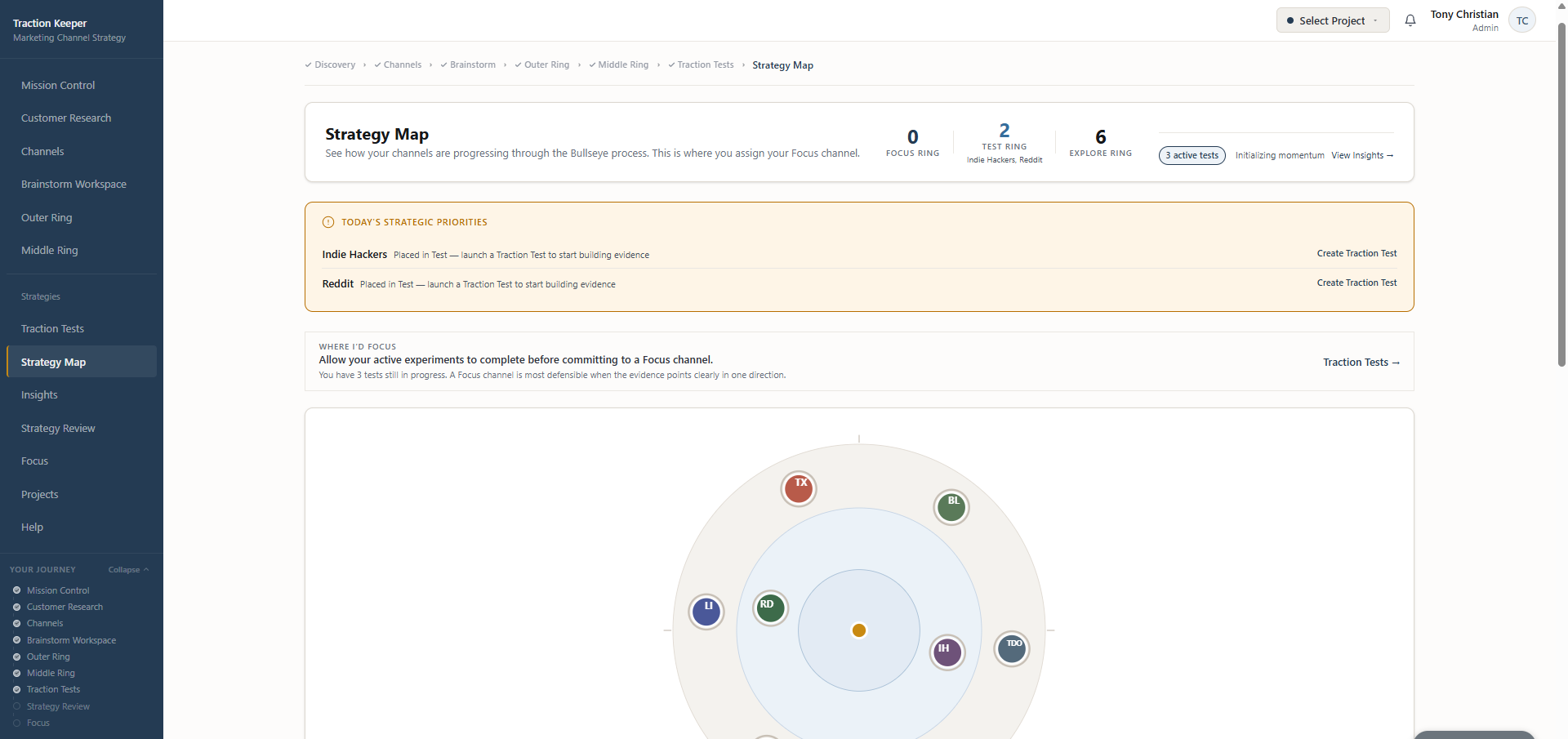
The Bullseye framework gives your channels a place on a three-ring map. The outer ring holds channels you’re aware of. The middle ring holds channels worth testing seriously. The inner ring is reserved for the channel that has earned concentrated investment through evidence, not enthusiasm.

You move a channel forward. Traction Keeper doesn’t do it for you.

The framework keeps you from spreading effort across too many channels at once by making the question visible: does this channel have enough evidence to deserve more investment, or is it still in the outer ring?

Once a channel is worth testing seriously, it needs a structure that can actually produce something you can learn from.
Step 4 of 8

Turn Ideas Into Experiments

There’s a difference between trying something and running an experiment.

When you try something, you spend effort and see what happens. When you run an experiment, you define in advance what you expect to happen and why. The result either supports your belief or it doesn’t. Either way, you learn something precise.

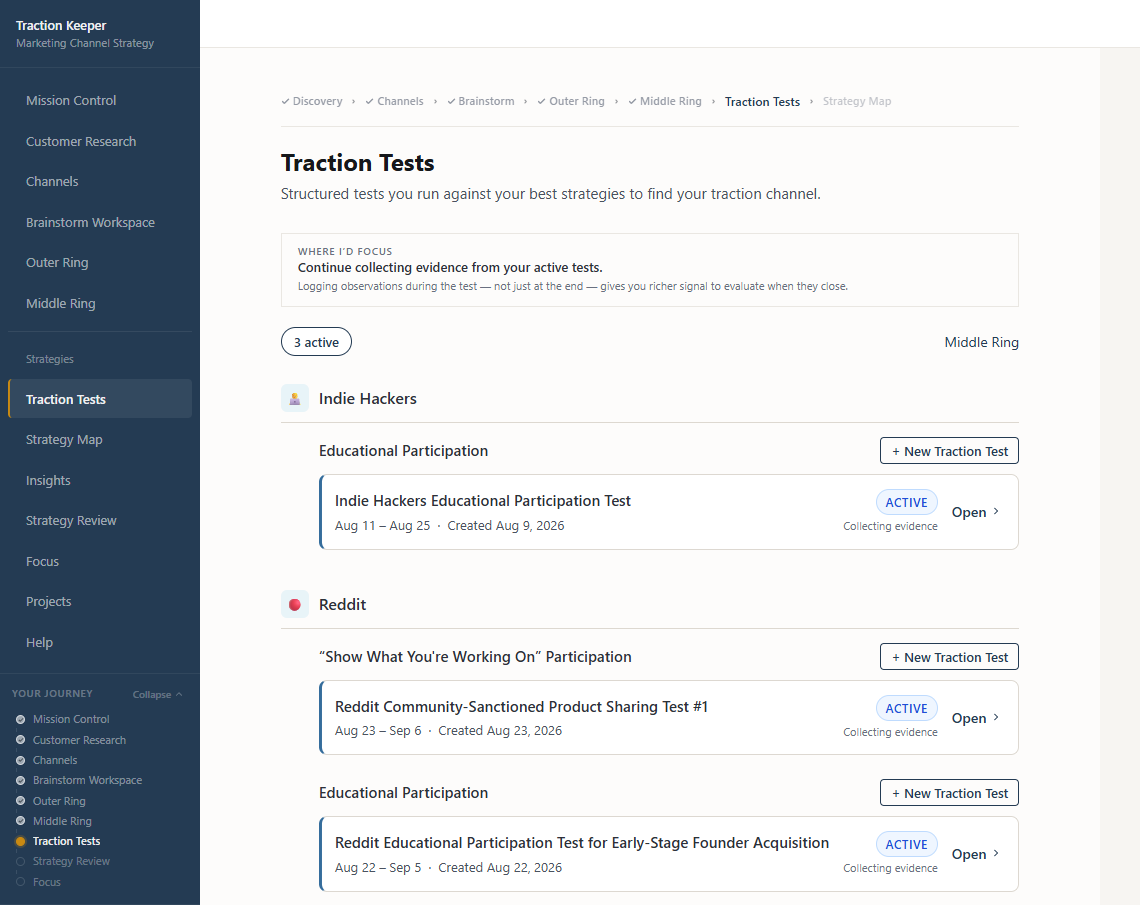
Traction Keeper structures this through Traction Tests. Before a test begins, you record:

This isn’t bureaucracy. It’s the difference between a result that produces a decision and a result that produces a shrug.

When the test ends, the record of what you expected is still there. You compare it to what you observed. That comparison is where the learning happens.

Step 4 continued

Keep the Work Connected

Channel Workspaces

Most founders track experiments in separate documents, spreadsheets, or nothing at all. The result is that context disappears between sessions and decisions get made without the record of what came before.

Each channel in Traction Keeper has its own workspace. All the Traction Tests you run for that channel live in one place, alongside the observations and notes you’ve accumulated along the way.

When you return to a channel, you don’t start from scratch. You can see what you’ve tested, what the results were, and what you believed at the time. That history is the context your next decision needs.

The work doesn’t disappear. It accumulates.

Capturing results is only the first part.

The second part is deciding what they mean.

Step 5 of 8

Reflect Before Deciding

Most experiments don’t produce clean answers.

The results come in. They’re neither clearly good nor clearly bad. And without a structure to reason about them, the tendency is to either keep going out of momentum or stop out of frustration. Neither produces learning.

When you close a Traction Test, Traction Keeper prompts you to reflect before you decide what to do next.

Did the result match what you expected? If not, why might that be? What does the result tell you about the channel, the audience, or the hypothesis you were testing?

Reflection isn’t a soft step. It’s the moment where a raw result becomes something you can reason from. Skipping it turns experiments into activity and prevents them from producing knowledge.

The reflection record stays attached to the test. What you conclude stays with what you observed, so future decisions can draw on your past thinking, not just your past data.

Step 6 of 8

Decide With Evidence

A channel decision is one of the most consequential things a founder makes. It commits time, which is the resource that can’t be recovered.

Traction Keeper gives each channel decision a structure. When you move a channel forward in the Bullseye or decide to stop testing it, you record what you decided and why. The evidence that informed the decision stays connected to the decision itself.

This matters more than it might seem.

Six months from now, you won’t remember why you stopped working on SEO in March. You won’t remember what the signal was that made you concentrate on partnerships. Without a record, those conclusions are invisible to future decisions.

With a record, you can see the pattern of what you’ve learned. You can revisit a decision when circumstances change. You can tell the difference between abandoning a channel because the evidence said stop and abandoning it because you ran out of patience.

The decision is still yours. Traction Keeper helps you make it with something to point to.

Step 7 of 8

Build Knowledge Over Time

Marketing knowledge is only useful if you can find it when you need it.

The common alternative is to rely on memory. Most founders discover the limits of that approach about six months in, when they realize they can’t recall what they tried, what it produced, or what they concluded at the time.

Every reflection and every decision in Traction Keeper builds a record that persists. Your experiments, your conclusions, your hypotheses that turned out to be wrong: all of it stays in the system.

This isn’t an archive for its own sake. It’s working knowledge you can return to when a similar question comes up again. It prevents you from re-learning things you already paid to learn.

Good founders revisit old conclusions when the context changes. They check whether an assumption they made twelve months ago still holds. They look for patterns across channels that only become visible with enough records to compare.

None of that’s possible if the knowledge exists only in your head.

Step 8 of 8

Know Where You Are Every Time You Return

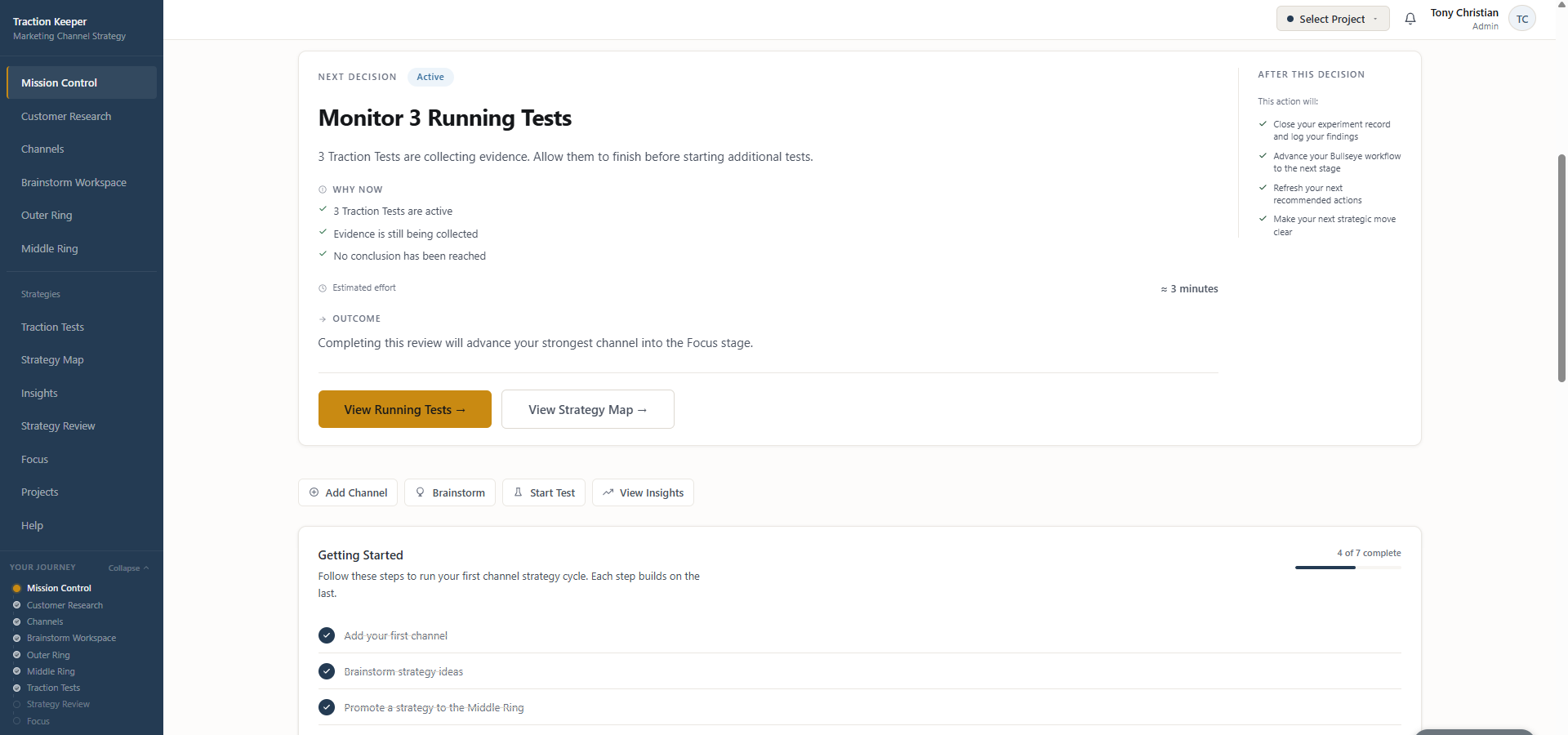
Mission Control

Every session has the same problem: you know you were making progress, but you can’t remember exactly where you left off.

Mission Control is the surface you return to at the start of each session. It brings together the current state of your marketing work: what’s running, what’s finished, where your channels stand in the Bullseye, and what most needs your attention today.

The goal is to spend your time on the work, not on reconstructing the context for the work.

Mission Control doesn’t make decisions for you. It orients you so that your decisions start from a clear picture rather than a reconstructed one.

It’s the final step in each cycle and the first thing you see at the start of the next one. The workflow is designed to loop: each cycle of experiments adds to the knowledge base, which informs the next round of prioritization, which makes the next set of experiments more purposeful.

Each of these steps is more useful because the others exist.

One Connected Workflow

The steps are designed to work together.

Understanding your customer makes exploration more purposeful. Exploration gives prioritization something real to work from. Prioritization makes experiments more deliberate. Experiments produce results worth reflecting on. Reflection produces conclusions worth recording. Decisions recorded become knowledge. Knowledge narrows the next cycle of exploration.

Most founders already do most of this, in some form, in their heads or across scattered documents. The problem isn’t that they lack a process. It’s that the process has no home, so the output disappears between sessions and the knowledge doesn’t accumulate.

Traction Keeper is the home for that process.

Understand Capture what you know about the customer and what you most need to learn.
Explore Map plausible channels without committing to any of them.
Prioritize Place channels in the Bullseye based on current evidence.
Test Define a hypothesis, run a structured experiment, record what happened.
Reflect Reason about what the result means before deciding what to do next.
Decide Record the decision and the evidence behind it.
Learn Preserve what you concluded so future decisions can use it.
Focus Concentrate where the evidence has earned it, and return to Mission Control each session.

Try It During Private Beta

Traction Keeper is in private beta. A small group of founders are using it now to run their marketing process. Request access and we’ll be in touch.

Share your email and we’ll be in touch.