Capabilities

See the System Behind Better Marketing Decisions

Every capability in Traction Keeper supports the same job: helping you gather better evidence, preserve what you learn, and make clearer decisions about where your marketing effort belongs.

This page shows the tools that make that process possible.

Session orientation

Know Where You Stand Before You Begin

Mission Control

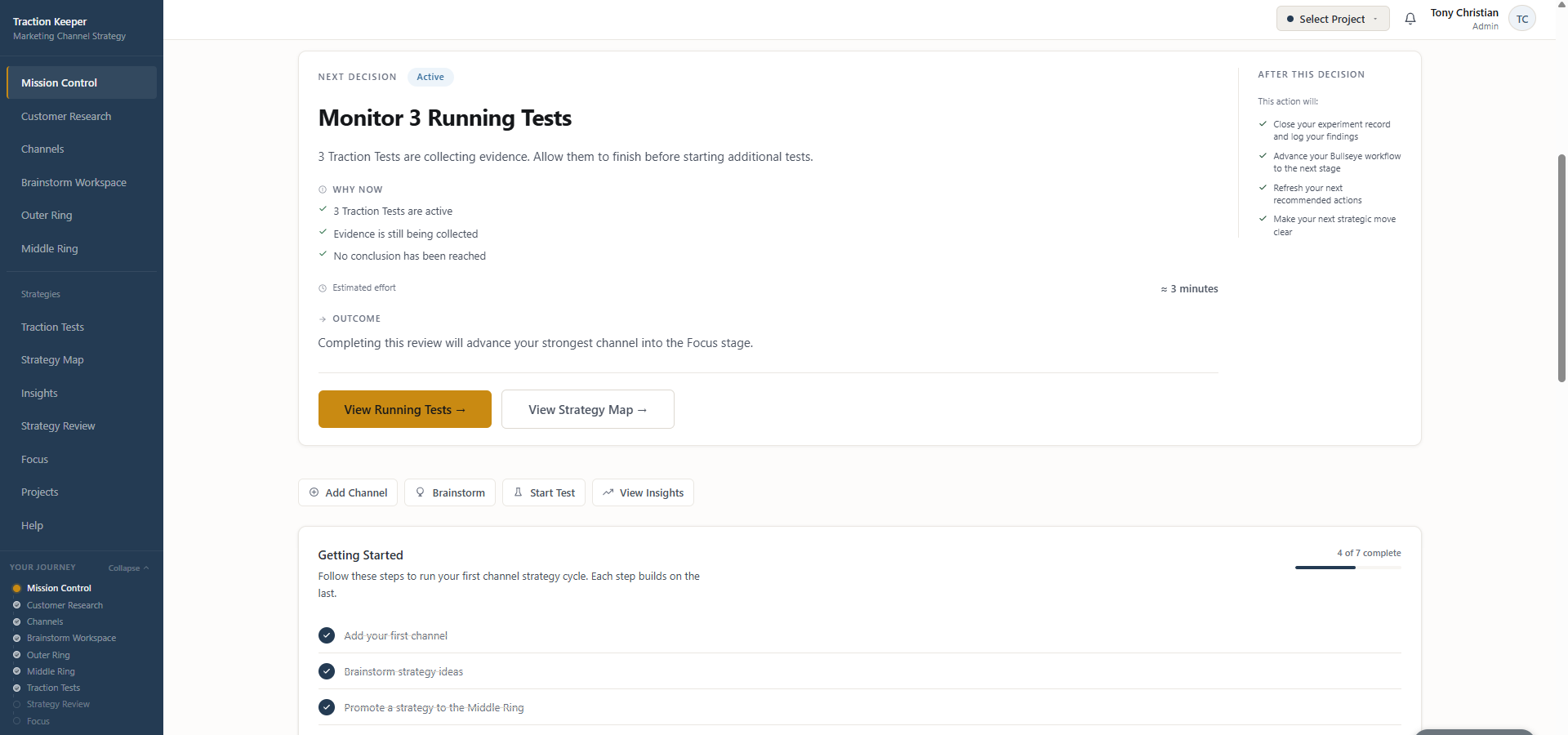
When you open Traction Keeper, Mission Control reads the current state of your workspace and surfaces the one thing that deserves your attention now.

What you see:

  • today's session priority, derived from where your work stands,
  • active experiments, so you never lose track of what’s running,
  • a snapshot of where your channels sit on the Bullseye,
  • recent learnings from experiments you’ve closed.

Mission Control doesn’t make the decision for you. It gives you a clear starting point based on the work already in your system.

The logic is rule-based, not AI.
Customer understanding

Keep Customer Evidence Close to the Decisions It Should Inform

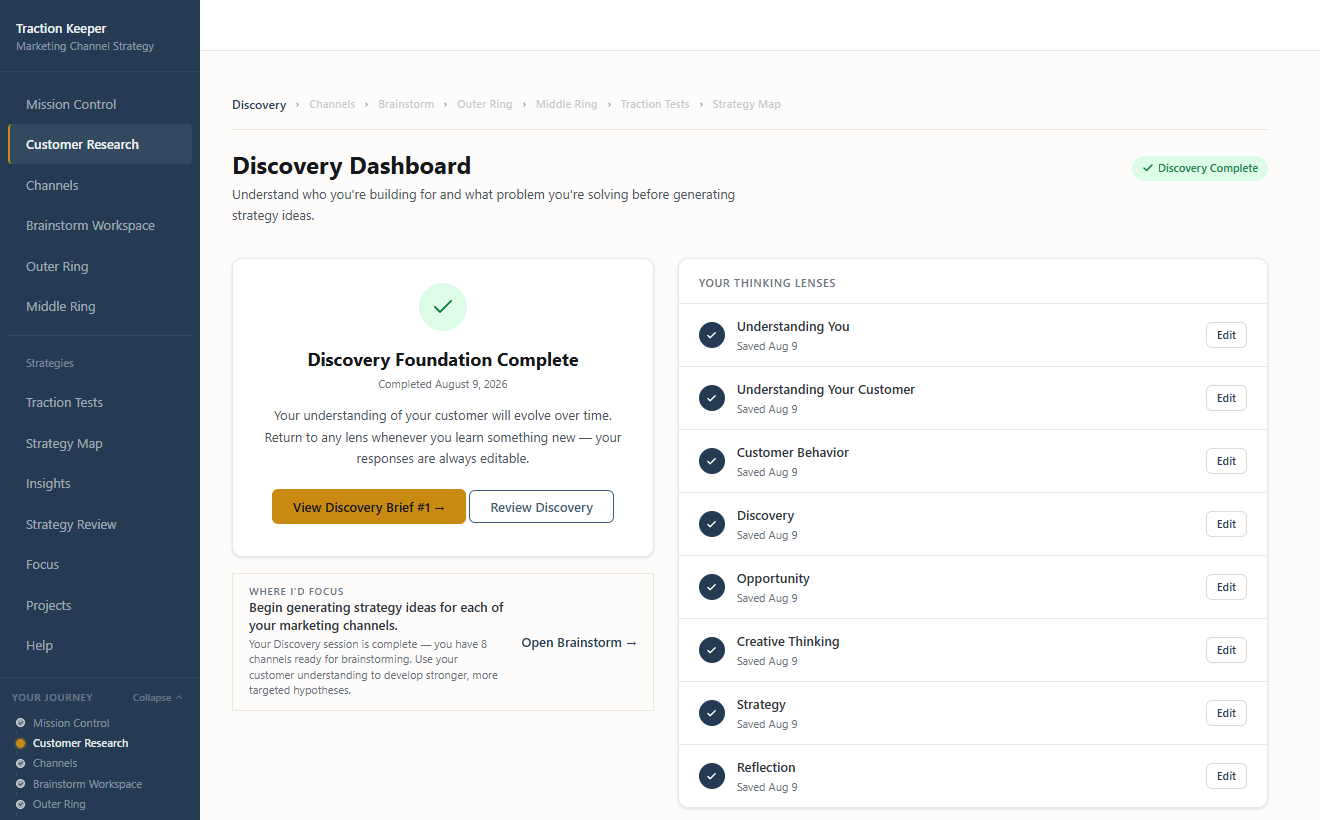
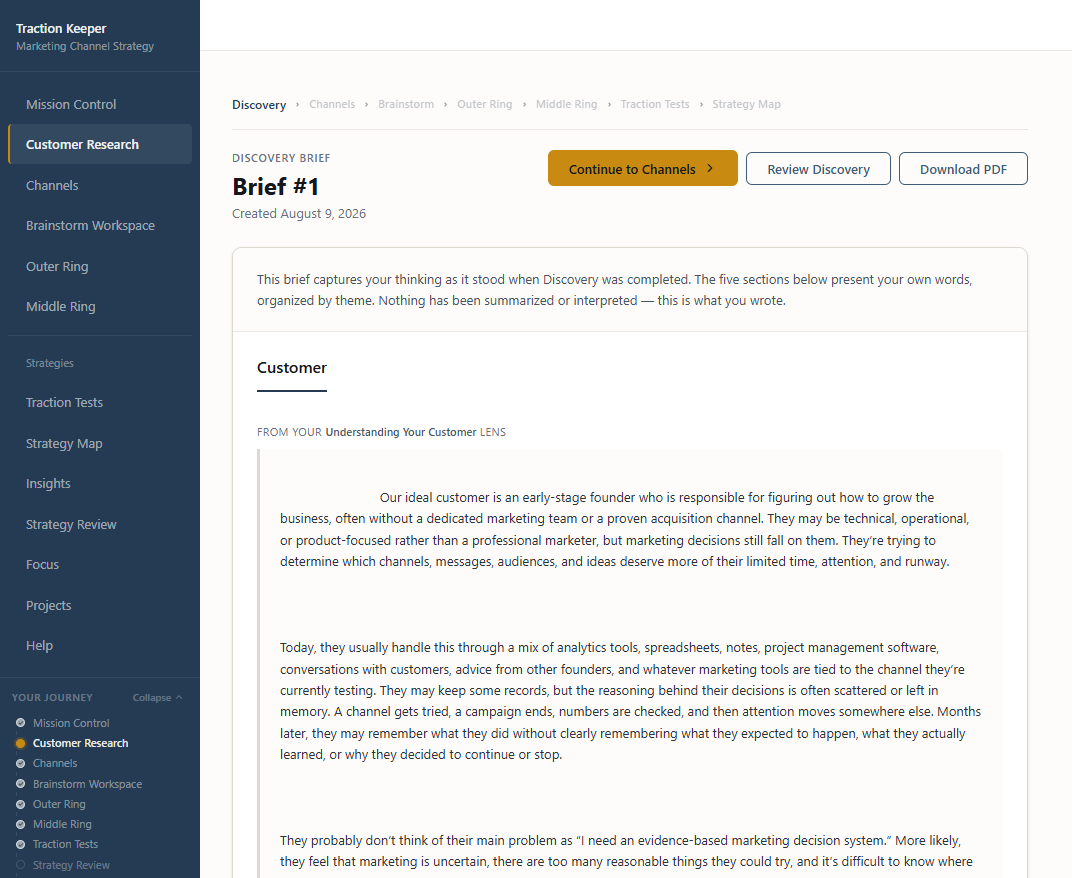
Customer Profile

This isn’t a persona template. It’s a living record of what you currently know, believe, and still need to learn about the people your product is for.

Capture the observations that could change which channels you test or how you design those tests:

  • problems you’ve observed directly,
  • language customers use,
  • recurring objections,
  • patterns across conversations,
  • assumptions that still need confirmation.

As your understanding changes, the profile changes with it. The goal is to keep customer evidence close enough to influence the next experiment.

Strategy foundation

Define What Success Looks Like in This Phase

Marketing Objective

"Get more users" isn’t a useful objective for designing experiments.

The Marketing Objective workspace gives your current growth goal the specificity experiments need. A useful objective names which segment you’re trying to reach, which outcome you need from reaching them, and how you’d measure that outcome.

A specific objective makes it easier to design useful experiments because you can ask whether each one actually tests something relevant to the goal. It also keeps the learning honest: the result either moves you toward that objective or it doesn’t.

The objective changes when the goal shifts. It isn’t a planning artifact. It’s a working document connected to the experiments running underneath it.

Idea generation

Collect Possibilities Before You Commit to Any of Them

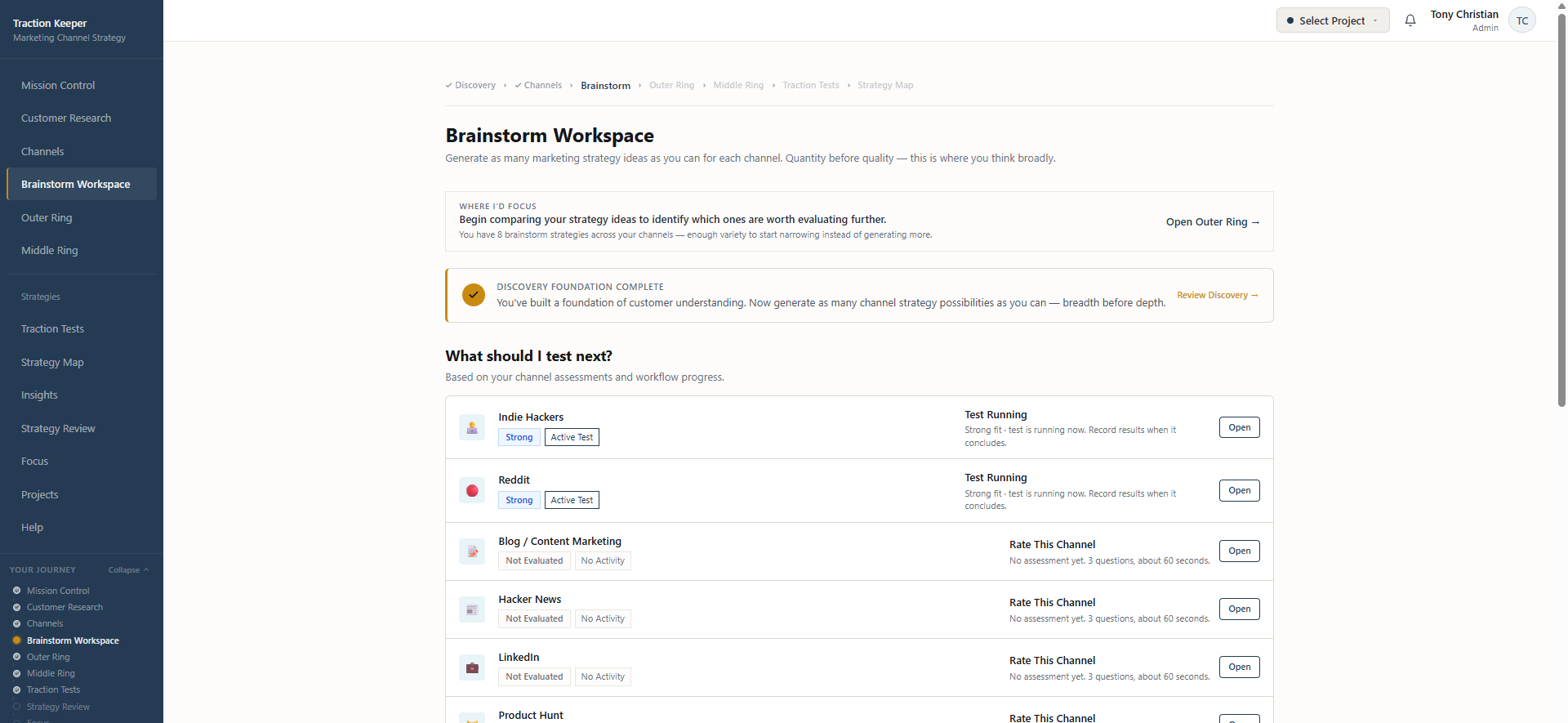
Channel Library and Brainstorm Workspace

You need enough options to explore without turning every option into work.

Traction Keeper gives you a library of 20+ marketing channels to consider, then a Brainstorm Workspace where you can explore channel-specific ideas before committing to formal experiments.

This matters because brainstorming and prioritizing are different jobs. Mixing them means every idea starts feeling like an obligation before you’ve had a chance to evaluate it.

Ideas in the Brainstorm Workspace are inexpensive. They become experiments only when you decide they’re ready to be tested.

Exploration creates options. The Bullseye determines how much attention each one has earned.

Channel strategy

Give Each Channel the Commitment Its Evidence Has Earned

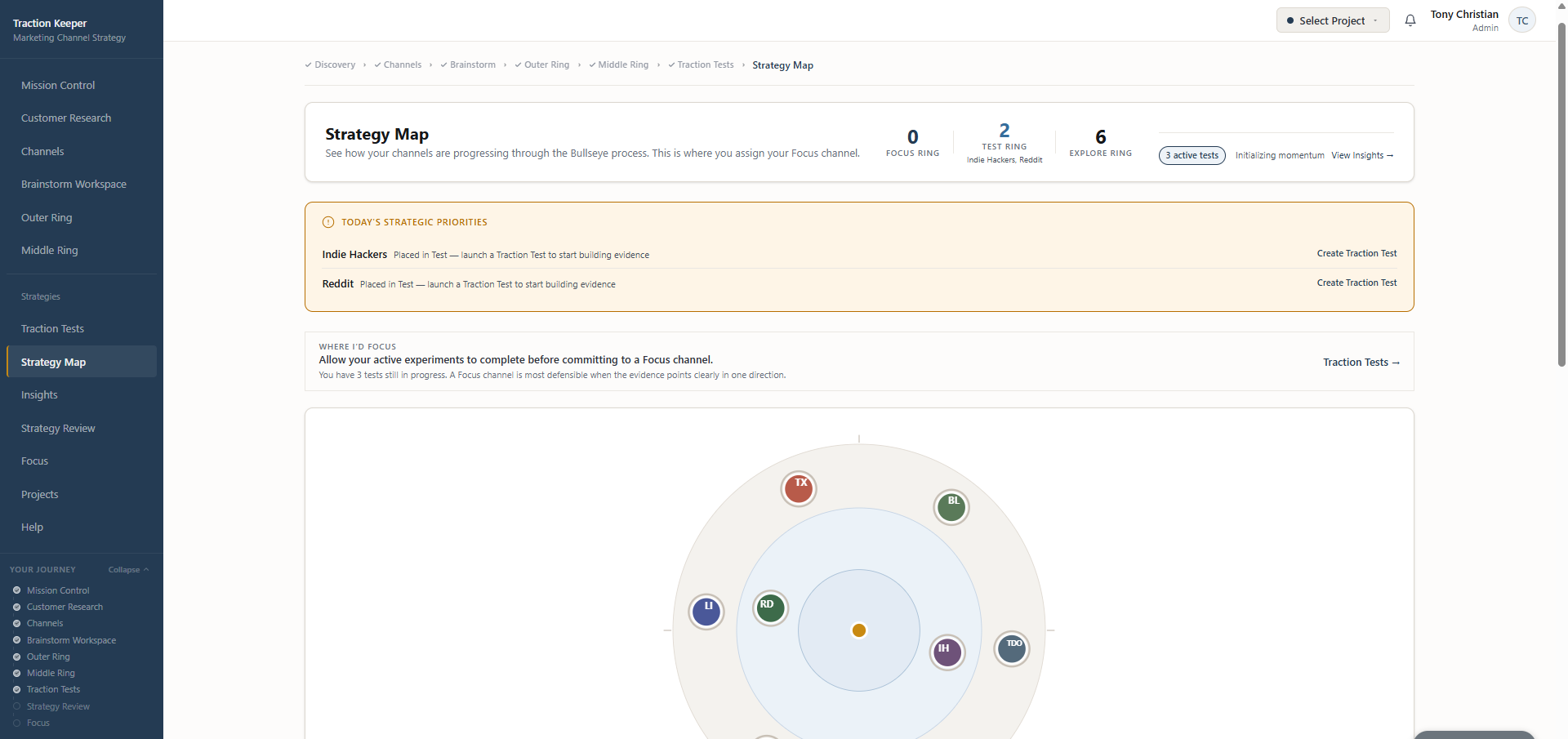
Strategy Map and Bullseye Framework

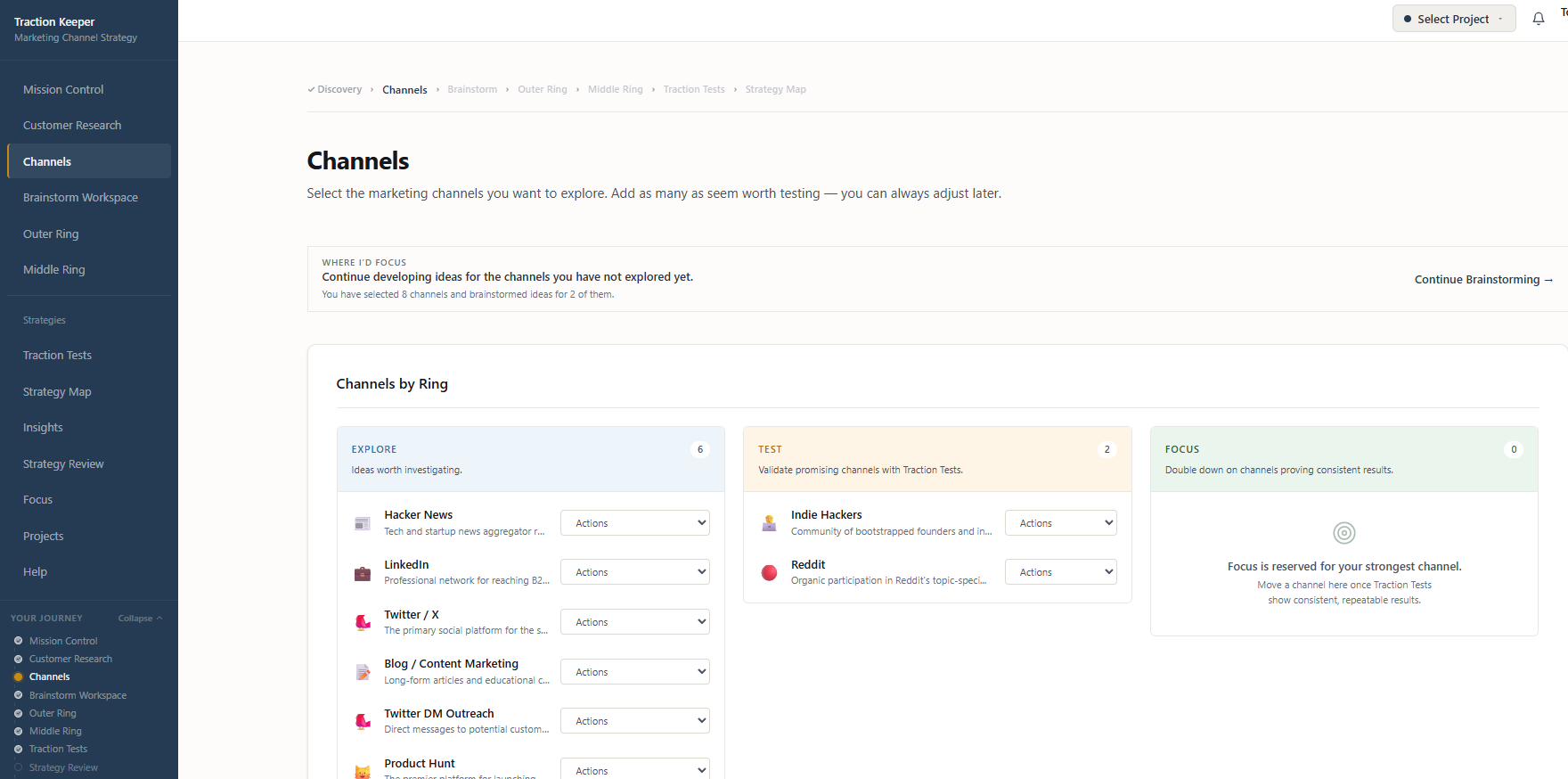
The Strategy Map visualizes your channels on three concentric rings. Each ring represents a level of evidence-based commitment.

  • Explore — low-cost investigation. You’re running initial experiments to see whether a channel produces enough signal to keep pursuing.
  • Test — committed experimentation. You’ve seen early signal and are investing more seriously to learn whether the channel is worth pursuing further.
  • Focus — concentrated investment. You’ve accumulated enough evidence to give the channel your full attention.

Each channel also shows an intelligence panel: its health tier, experiment count, success rate, and confidence level based on accumulated results.

You decide when a channel moves from one ring to another. Evidence informs the decision. Traction Keeper never moves a channel on its own. You review what the experiments show and decide what it means.

A ring position is still a hypothesis about a channel. Experiments are how that hypothesis earns stronger evidence.

Structured experimentation

Run Experiments Designed to Produce Something You Can Learn From

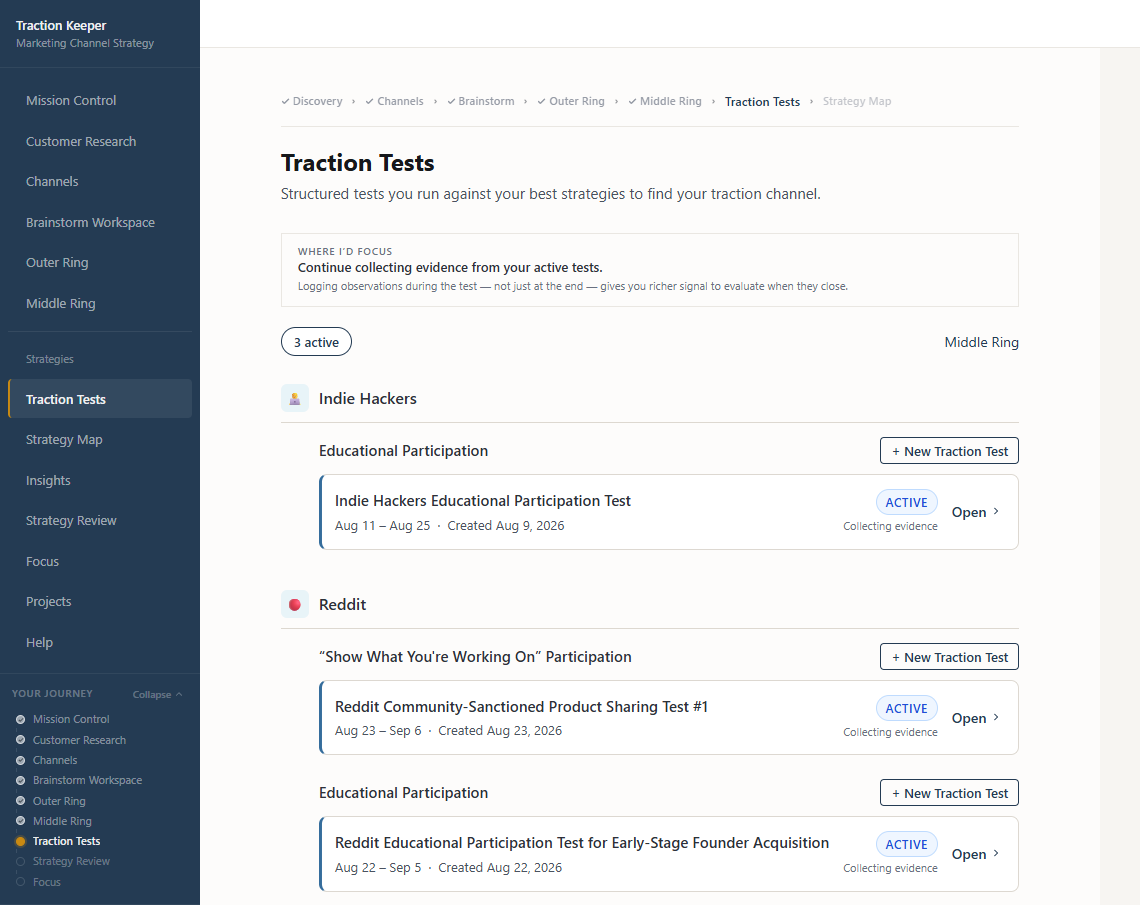
Traction Tests

A Traction Test isn’t a campaign. It’s a structured experiment with a hypothesis recorded before you begin.

When you create a Traction Test, you define:

  • the hypothesis — what you predict will happen and why,
  • the success criteria — how you’ll know if the hypothesis was confirmed,
  • the timeframe — how long the experiment will run,
  • the metrics — what you’ll measure, entered manually as results come in.

During the test, you track completed actions and record metrics manually as results come in. Traction Keeper doesn’t connect to analytics or ad platforms today.

The Experiment Journal records every significant event chronologically: status changes, metric entries, and notes. When you finish a test, the original hypothesis is still there, alongside what you observed. The comparison is where the learning happens.

Running the test creates evidence. Closing the test turns that evidence into learning.

Closing an experiment

Don't Let the Result Be the End of the Experiment

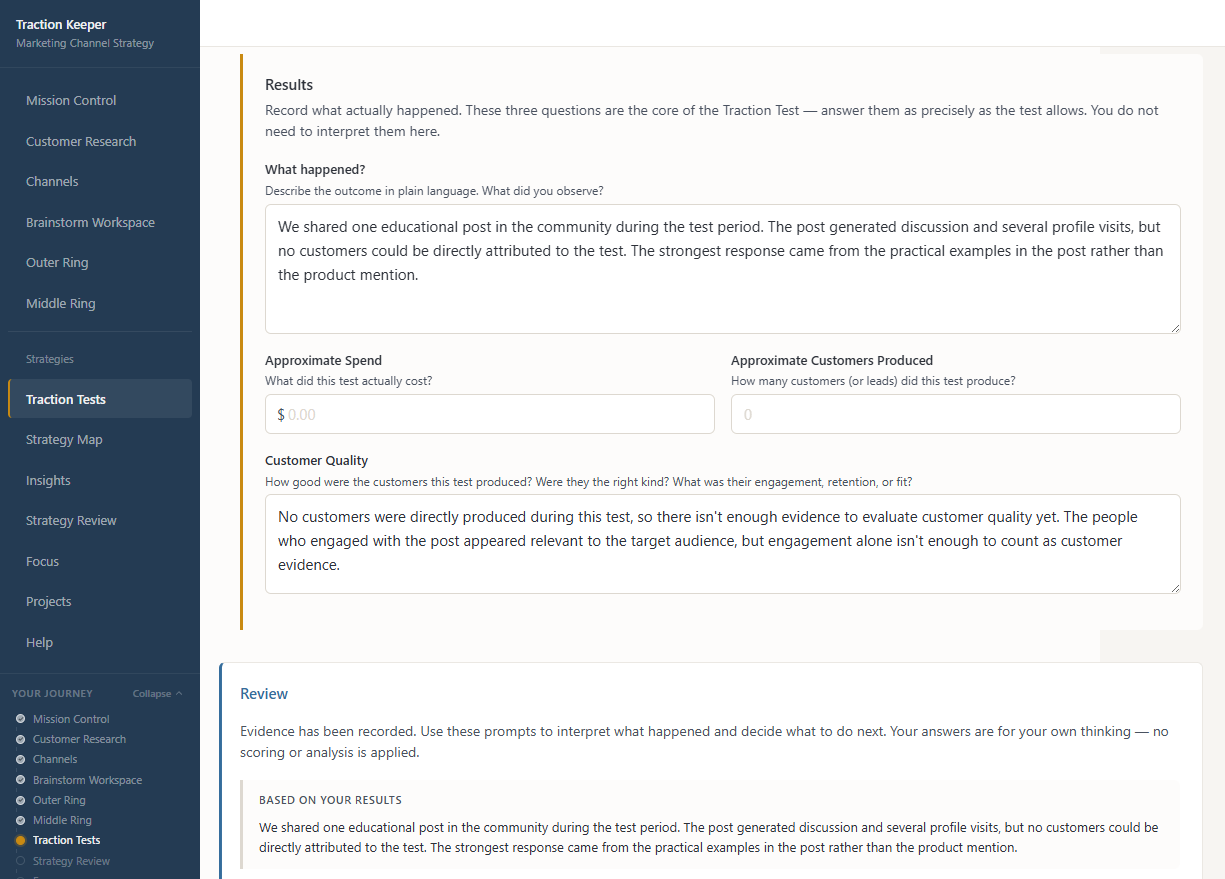
Experiment Result and Lessons

Finishing the work gives you a result.

It doesn’t automatically give you the lesson.

When a Traction Test closes, Traction Keeper asks you to classify what happened and preserve what you learned before moving on.

You classify the result:

  • Success — the hypothesis was confirmed,
  • Failure — the hypothesis wasn’t confirmed,
  • Learning — the experiment produced a meaningful insight regardless of outcome,
  • Pause — the experiment was stopped before conclusion for a documented reason.

After classification, you record lessons: what worked, what didn’t, and whether you’d run this experiment again. All of this stays permanently attached to the experiment, connected to the original hypothesis and the recorded results.

None of this is classified or interpreted for you. The result is yours to evaluate. The structure makes sure you capture that evaluation before moving on.

Per-channel view

See Every Experiment on a Channel in One Place

Channel Workspace

Every channel has its own history.

The Channel Workspace brings together the experiments you’ve run on that channel, their results, and the current performance signals attached to it.

You can see:

  • experiments and results,
  • health tier and confidence,
  • experiment count and success rate,
  • what you’ve already tried.

That means the next decision begins with context instead of memory.

Once that history exists, the next question is whether your decisions can be traced back to it.

Evidence-based decisions

Connect Every Channel Decision to the Evidence Behind It

Ring Movement and Learning Feed

Moving a channel on the Bullseye is a strategic decision.

The evidence you used to make that decision should still be available months later.

Traction Keeper preserves the experiments, results, classifications, and lessons behind your channel history so you can return to the record instead of reconstructing the decision from memory.

The Insights learning feed gives you a chronological view of completed experiments and what you concluded at the time.

That matters because memory changes under pressure. The evidence you recorded doesn’t.

One decision preserves a lesson. A history of decisions begins to reveal a pattern.

Accumulated learning

Build a Record That Gets More Useful the More You Use It

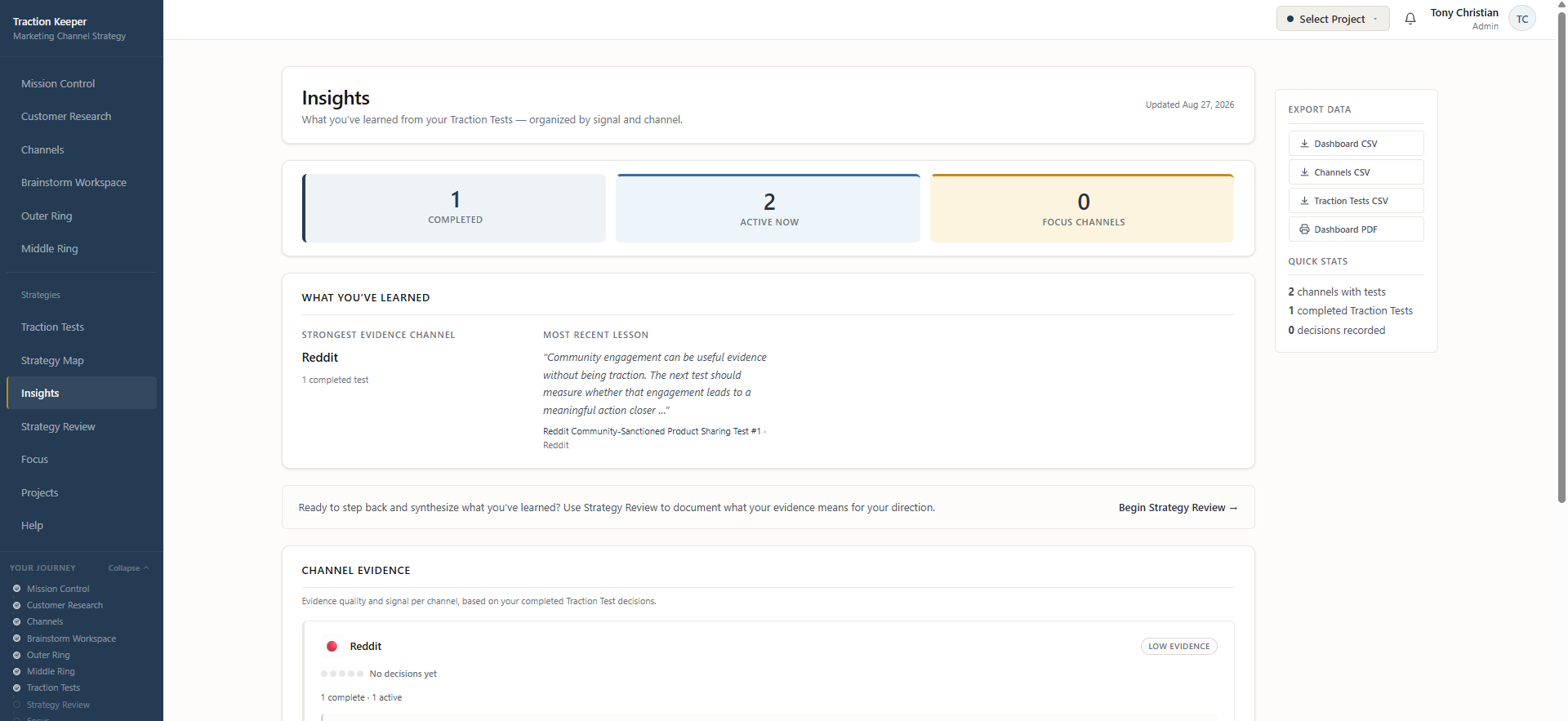
Insights

One experiment gives you a result.

Several experiments begin to reveal patterns.

Insights gives you the cross-experiment view:

  • channel performance rankings based on accumulated results,
  • a learning feed of completed experiments and classifications,
  • cross-channel comparison.

This is where individual experiments begin to improve later decisions. A failed test can rule out an assumption. A repeated signal can strengthen a channel. Patterns that were invisible inside one experiment become easier to see across many.

The record persists. It gets more useful the more you add to it.

The longer you use the process, the less often your next decision has to begin from zero.

Bring Your Real Marketing Decisions Into Private Beta

Traction Keeper is in Private Beta. We’re inviting founders who are actively testing marketing channels and want a more disciplined way to preserve what they learn.

Bring real experiments, real uncertainty, and real decisions. Your experience will help us understand where the system creates clarity and where it still creates friction.

Share your email to request access.